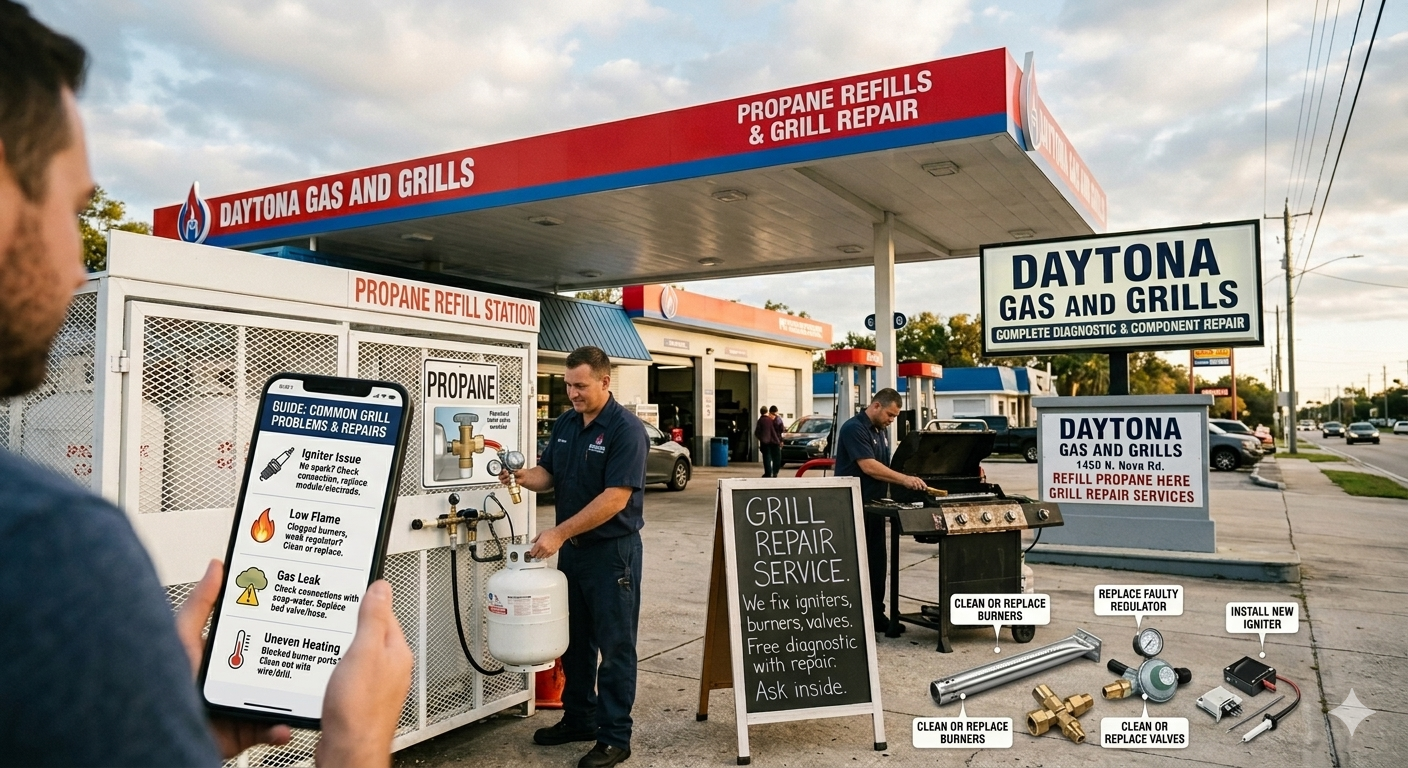
What Are Common Propane Grill Problems and How Are They Repaired Nothing ruins a backyard cookout faster than a propane grill that refuses to light, delivers uneven heat, or shuts off mid-cook. Most grill owners face at least one of these frustrations every season, yet very few know how to diagnose and fix them quickly. This guide walks you through the most common propane grill problems, explains exactly what causes each one, and shows you how to repair them — whether you handle it yourself or call a professional. You will also learn when to search for propane grill repair near me and where to find the nearest propane refill station before your tank runs dry at the worst possible moment.
Problem 1: The Grill Will Not Light at All
This is the most common complaint propane grill owners bring to technicians every summer. It almost always traces back to one of these root causes:
• Empty or improperly connected propane tank — confirm the tank has fuel and the regulator connection sits tight with no movement
• Faulty igniter module or electrode — press the igniter and listen for a clicking sound; no click means the igniter has failed and needs replacement
• Clogged burner tube — insects, particularly spiders, frequently build nests inside burner tubes during off-season storage, blocking gas flow entirely
• Tripped safety valve on the regulator — caused by opening the tank valve too fast, which restricts gas as a precaution
For igniter replacements and compatible burner tube kits, specialty retailers like Daytona Gas and Grills stock parts for a wide range of grill brands and can often identify the right component by model number. If the igniter clicks but no flame appears, remove the burner tubes, clear any obstruction with a thin wire brush or pipe cleaner, and test again before calling for professional help.
Problem 2: Weak, Yellow, or Uneven Flame Across the Burners
A grill that produces inconsistent heat across the cooking surface makes it nearly impossible to cook food evenly. The two most frequent causes are a tripped regulator and clogged burner ports. Here is how to address both:
Resetting a Tripped Regulator
Turn off all burner knobs, close the tank valve completely, and disconnect the regulator from the tank. Wait a full 60 seconds, then reconnect everything and open the tank valve slowly before relighting. This simple reset clears the safety restriction and restores full gas pressure to the burners in most cases.
Clearing Clogged Burner Ports
Grease, food residue, and rust accumulate inside the small holes along each burner over time. With the gas completely off, use a stiff wire brush to clean the burner ports along the full length of each burner. Relight and check whether the flame now distributes evenly. If cleaning does not resolve the issue, the burner has likely corroded through and needs direct replacement — a quick job for any propane grill repair near me technician.
Problem 3: The Grill Lights but Goes Out Within Seconds
A grill that ignites and immediately extinguishes points to a venturi tube blockage or a failing regulator. The venturi tubes are curved metal channels that mix air and gas before feeding the burners. When insects nest inside them during storage, the air-to-gas ratio becomes disrupted and the flame dies within seconds of ignition.
Remove the venturi tubes, inspect each one with a flashlight, and clear any blockage with a venturi brush or pipe cleaner. If the problem continues after cleaning, the regulator likely delivers inconsistent pressure. Regulators have a typical service life of 10 to 15 years. A technician at a local grill service center or a shop like Daytona Gas and Grills can pressure-test the regulator and replace it on the spot if it fails the test.
Problem 4: You Smell Gas Without Any Visible Flame
A propane odor near your grill — especially when it is turned off — signals a potential gas leak that you must address before lighting the burners again. Follow these steps in order:
• Do not attempt to light the grill under any circumstances until you locate and fix the leak
• Mix dish soap with water and brush the solution over every gas connection — the tank valve, the regulator hose fitting, and all connections at the burner manifold
• Watch for bubbles forming at any point; bubbles identify the exact leak location instantly
• Tighten any loose fittings with a wrench and retest with fresh soapy water
• Replace any hose showing visible cracking, brittleness, or physical damage — UV exposure and heat cycling degrade propane hoses over time
• If the smell persists after tightening all connections, stop using the grill and contact a propane grill repair near me professional immediately
A gas leak is the one propane grill problem you should never troubleshoot casually or delay fixing. A certified technician carries the equipment to test your full gas line safely and identify hairline cracks that the soapy water test misses.
Problem 5: Grease Fires and Intense Flare-Ups Inside the Grill
Sudden flare-ups that produce black smoke and uncontrollable heat inside the grill almost always come from grease buildup — not an ignition or gas pressure issue. Accumulated grease in the drip tray, on the flavorizer bars, or around the burner covers ignites when cooking temperatures rise. The solution is a thorough deep clean:
• Let the grill cool completely before starting any cleaning
• Remove the cooking grates, flavorizer bars, and drip tray
• Scrape off accumulated grease with a dedicated grill scraper, then wash each component with warm soapy water
• Inspect the drip tray for warping — a warped tray prevents proper grease drainage and creates a recurring flare-up problem
• Reassemble and run the grill on high for 10 minutes with the lid open to burn off any remaining residue
Grilling professionals recommend performing this deep clean every 10 to 15 cooking sessions, or more frequently when cooking fatty meats. A well-maintained grill delivers consistent cooking temperatures, lasts significantly longer, and creates far fewer dangerous situations.
When to Call a Professional and Where to Find Propane Near You
Some propane grill repairs are straightforward DIY tasks that most homeowners complete in under 30 minutes with basic tools. Others require professional equipment and certified expertise. Use this quick reference to decide which path fits your situation:
• DIY-friendly repairs: igniter replacement, burner tube cleaning, venturi tube clearing, hose swap, regulator reset, drip tray replacement
• Call a professional for: regulator replacement, internal valve repair, gas line pressure testing, manifold issues, and any repair where a gas smell persists after basic fixes
Searching for propane grill repair near me connects you with local certified technicians who diagnose and fix complex issues correctly on the first visit, removing the safety risk that comes with improper gas appliance repairs.
When your propane tank runs low, finding the nearest propane refill station quickly saves your cookout. Most hardware stores, home improvement centers, and dedicated gas supply companies such as Daytona Gas and Grills offer both tank refills and tank exchange programs. Refilling your existing tank costs less per gallon than exchanging it and keeps the tank you already own — which matters if yours is newer and still in excellent condition. Call ahead to confirm availability and ask whether the location offers certified cylinder inspection alongside the refill, which extends your tank’s safe service life.
Keep Your Propane Grill Running Safely All Season Long
Propane grill problems almost always have clear, fixable solutions when you catch them early and respond correctly. A grill that will not light, runs hot on one side, or smells like gas is not necessarily finished — it usually needs a targeted repair, a specific part, or a proper cleaning. Handle the simple fixes yourself, rely on trusted local resources like Daytona Gas and Grills for parts and expert repairs, use the nearest propane refill station to keep your tank ready before every cook, and schedule a full inspection at the start of each grilling season. A well-maintained propane grill delivers reliable, even heat for 10 to 20 years — making every backyard cookout exactly what it should be.